- Quoted phrase in the opening sentence
- Opening quote: “hacks.ycombinator.com”
Summary of n°I-1358:
- It's a tax on internet "content", but they haven't defined what that means exactly, so by default it would apply to all internet traffic.
- Bytes delivered to French users by ISPs are taxed (but not user uploads).
- ISPs are responsible for tracking exactly where every GB originates from and will have to report the names to the government.
- The "content provider" then has to pay 0.055 EUR per GB that they sent.
- No explanation for how user-to-user traffic is handled. No explanation for what ISP -> user means (e.g. does P2P count)? No details on how ISPs will track the upstream source. About a million other similar questions are unanswered.
- The amendment was adopted today, and the assembly will vote on it as part of their full budget (but there are still many stages left before it can become law). Even by government standards this is way too idiotic to actually come into effect.
You only need a handful of occasions of creating massive billing errors for your customer's customers before they will slag you to all their CTO friends and pull the plug. Imagine Stripe began double-charging every third transaction once a week, and couldn't fix it after two months of thrashing because no one there has any understanding of how anything works anymore. They are simply done at that point, all the value of their brand lost.
If you don't ride your bicycle for years and years because you can just write "drive yourself"
Then your skills are atrophying. Typing isn't a skill
If AI can handle it, great! We have a new tool -- let's make the tool better.
Let's figure out how to use AI to make us detect and resolve issues faster, and even better, prevent issues. I've always said we can't consistently hit 5 9's without automatic detection and remediation. We are there now.
Let's get everyone to 5 9s with AI!
The autopilot does not do "almost all critical work", not even close. It only does some of the routine work (definitely not all of it). But the real critical work is when stuff goes wrong, dealing with emergencies.
The inherent complexity of aviation means that there are so many different failure modes and combinations thereof that no traditional system could ever handle all possibilities and edge cases.
I'm not going to claim that an AI could never do it. But as of right now, with current technology, well-trained pilots are absolutely critical to safety in even the most advanced airliners.
Also, the survivorship bias argument runs against you. Most events where pilots save the day are completely invisible. Like catching an incorrect clearance, a misconfigured approach, dealing with a technical malfunction, etc.
And even when disasters happen, it is very rare that simply engaging the autopilot would have saved the day. In fact, there are plenty of examples where the opposite is the case, and dropping to a lower level of automation would, in hindsight, have been better.
"Security is for losers"
> Andy Yen, the CEO of Proton, had a message for an employee in the company’s security Slack channel who urged the company to at least take a few days to pentest newly written code before pushing it live. “That’s bullshit and loser thinking. Of course it’s possible to be fast and secure,” Yen wrote in the channel at the end of August. “Stop thinking always of how to be slower, and focus more on how to be faster.” In a follow-up message, Yen reiterated his point: “only losers think like that.” His ultimate message for the team was to “stop lovingly handcrafting all our code and use AI more.”
Proton CEO Andy Yen: "This will be the last year that we hire engineers." - https://news.ycombinator.com/item?id=50295112 - October 2026
Manifestos, Fear, and 'Loser Thinking': Inside Proton's AI Reckoning - https://news.ycombinator.com/item?id=50289692 - October 2026
Good luck.
Edit: There appears to be some consequences for acting like this and those actions being made public.
Proton's CEO Cancels AI 'Re-Interviews' - https://news.ycombinator.com/item?id=50307183 - October 2026
- Quoted phrase in the opening sentence
- Opening quote: “DevOps”
- Quoted phrase in the opening sentence
- Opening quote: “peak gaming”
Once PS3 and Xbox 360 came in picture, things changed slightly since they relied more heavily on their network services… albeit, PSN back then was free for online gameplay. These were on the same generation as Wii, but Wii was a winner for casual playing.
It would be more efficient to ban cars in favor of mass transit. It would be more efficient if people only lived in apartment complexes rather than standalone houses. Tons of things can be more "efficient" if you take away people's desire for privacy and ownership.
- Opening sentence uses a quote to challenge or distance a term
- Opening sentence challenges the term “your computer isn't idle sometimes”
What they did was to say "hey, we can leverage your idle computer to help process this".
Different perspective.
Also, I'd be very surprised if the current rush to build datacenters everywhere is optimal usage of resources. How many companies are building datacenter commons and sharing with other companies to optimize resource usage?
> Two statements can be true
As I general point, because I keep seeing this line on HN: Of course they can in the general case, but more often than not, the reason why this line is written is because there is some tension or contradiction between the statements. In that case, understanding where the tension lies is IMO more useful than shrugging and deciding to "hold two contradictory thoughts in your head" like in 1984.
Sometimes it feels like a rhetoric device to "rescue" an opinion when the opposite opinion is hard to argue against.
That doesn't mean anything. All of the code in a browser is "automation" -- normal users aren't hand-crafting the hundreds of HTTP requests the browser makes to render a single web page. Meanwhile there is a human somewhere telling the scrapers what to scrape.
> You are entitled to your own emails, posts, etc
Is that somewhere in the proposed text?
> but you are not entitled to crawl the internet for your own purposes without stating what they are and allowing websites an opt out.
"Stating what they are" buys you nothing when you have no way of verifying it, and you're still not providing any way to distinguish this from investigative journalism or e.g. a new competing search engine.
It does seem like this bill mostly affects normal users and is suspect with more surveillance being pushed. However the biggest problem is that the internet is global and the fees only apply to the US. If bots from Russia, China, India, or even France are scrapping then how would this even reduce the bots? Seems more like a new 'contempt of business model' is the purpose of this bill.
- Quoted phrase in the opening sentence
- Opening quote: “austerity”
What’s more fun is that while france is teetering on the brink, it’s hardly alone, and it’s collapse will tip the dominoes.
Something to look forward to, I guess.
- Quoted phrase in the opening sentence
- Opening quote: “Elements of Euclid”
(bottom of the readme)
This is to say, the stated goal and the target of the crypto enthusiasts are misaligned. To transcend the institutions represented by the fiat system requires far more than creating some alternative "currency", rather it requires creating an entirely new power structure.
1) unregulated gambling (a.k.a. "prediction markets"),
2) funding North Korea.
Heartening to see the beautiful web3 vision come alive.
This is to say, the stated goal and the target of the crypto enthusiasts are misaligned. To transcend the institutions represented by the fiat system requires far more than creating some alternative "currency", rather it requires creating an entirely new power structure.
- Quoted phrase in the opening sentence
- Opening quote: “losers”
Note how he says that he wants to 'acknowledge' things. Not apologize. Not that he is wrong about the re-interviews. He says he didn't use nice enough language to soften the blow. Basically, in simple terms, he didn't Lisa it up as temporary refund adjustment.
edit: and the passive voice is a cherry on top
edit2: I gotta say -- all those CEOs are getting a little uppity for people who likely use copilot for summarizing emails.
Have people completely lost their humanity? Is winning at whatever you’re doing that important we can’t be equally obligated to show each other decency?
"Manifestos, Fear, and 'Loser Thinking': Inside Proton's AI Reckoning" https://news.ycombinator.com/item?id=50289692 67 comments
"Proton goes all in on using AI" https://news.ycombinator.com/item?id=50296602 110 comments
"Proton to 'Re-Interview' Staff About AI to See Who Gets to Keep Their Job" https://news.ycombinator.com/item?id=50251062 48 comments
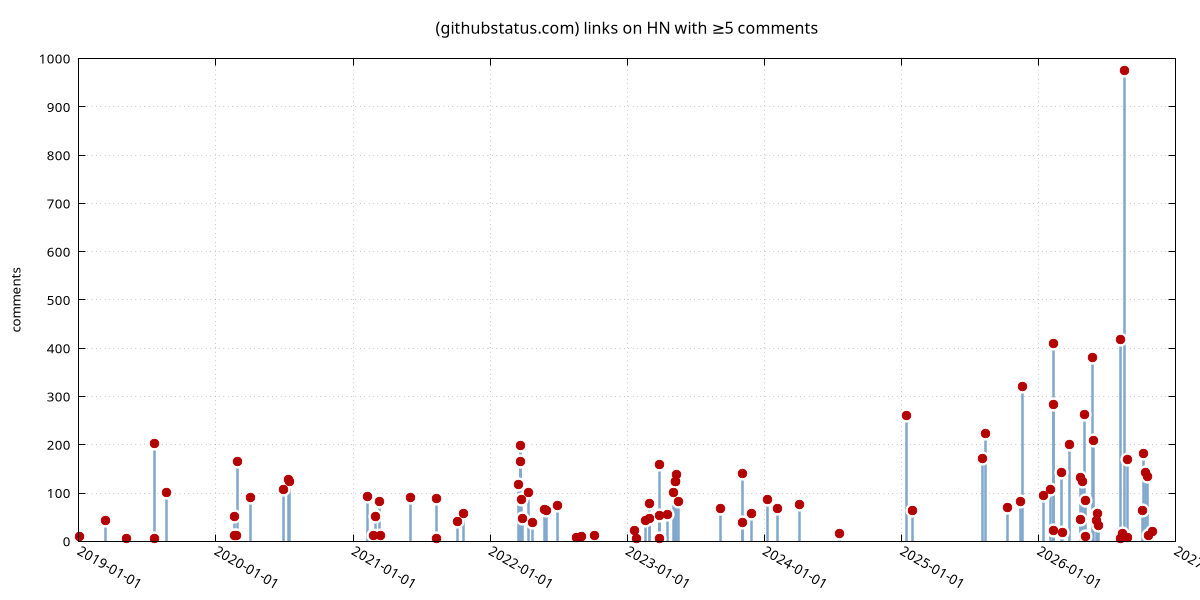
https://news.ycombinator.com/from?site=githubstatus.com
It's driven by aggregated user complaints, so it's pretty high-quality. Comment counts are a proxy for "how bad was the outage" + "how long was the outage thread topical for".
edit to add: Here's a scatterplot of the same,
It's a very typical failure mode for publicly-traded companies. For a CEO to have the incentive to do something that will kill their company, in a few quarters' time—in exchange for a one-off windfall that will boost the stock price, CEO compensation, &c. Short-termism at the "eating the golden goose" level.
> [May 2024] "In its IPO prospectus, Reddit revealed that it has contractual agreements to license its data to customers including Google worth a combined over $200 million. And, in its first earnings report as a public company, Reddit reported a 450% year-over-year increase in non-ad revenue, attributable mainly to those agreements."
> "Reddit stock was up 11% in extended trading following the announcement of the OpenAI deal."
https://techcrunch.com/2024/05/16/openai-inks-deal-to-train-...
Theres “big bets” and then there’s heavily leveraged bet the farm with leveraged debt. The first one hurts when it pops. The second one wipes people out.
Blackstone told investors Anthropic may not receive an investment-grade rating immediately after going public, a reversal from its previous guidance that would complicate the AI lab’s ability to finance its massive spending.
The private capital giant told investors in Anthropic’s latest $63bn chip financing deal that the start-up is expected to receive a “high” junk rating from major credit rating agencies after its initial public offering, according to people familiar with the matter.
Blackstone is acting as an anchor investor on the deal, known as “Project North Star”, and is working with banks that stumped up financing on selling the debt on to other investors.
Anthropic filed to go public on Monday, setting up what could be the largest listing of all time next month. The AI lab’s prospectus sketched out its “bold but sane” plans to spend more than $800bn on computing infrastructure between now and 2045.
An investment-grade credit rating is central to those ambitions, enabling Anthropic to borrow at lower rates to finance its AI infrastructure projects. The group has cash and equivalents of more than $112bn, and investors anticipate it could raise about $100bn more in the IPO. Sign reading "Blackstone" outside the Blackstone headquarters in New York, with pedestrians and city lights reflected in the glass. Blackstone’s funds have invested in $9bn of the junior debt at a lucrative yield of more than 10% © Angus Mordant/Bloomberg
While Blackstone had told its investment partners in recent months that it was expecting an investment-grade rating for Anthropic before year-end, it has recently signalled that a rating in the double B range or above is more likely given the guidance it has received from major credit agencies, the people said.
Such a designation would limit the pool of capital that Anthropic could tap because many insurance and pension funds are restricted from taking large positions in junk-rated borrowers. As a result, the company might need to continue to rely on its suppliers with high credit ratings to support its debt-raising efforts.
US tech stocks slid to session lows on Friday following the FT’s report on Anthropic’s rating, with the Nasdaq 100 down 3.7 per cent in afternoon trading. Markets were sharply lower prior to the report after earnings from Amazon and Intel worsened fears about the sustainability of the AI boom.
“It’s all about access to credit, it really matters . . . if [Anthropic] isn’t investment grade, the cost of credit goes higher, that’s not good for anyone,” said a US tech-focused portfolio manager.
“It’s a bloodbath out there,” they added, referring to the sell-off in stocks.
Wall Street banks earlier this week closed the North Star deal, which provides the financing for Anthropic to lease 1.5 gigawatts of Google’s semiconductors. More than $42bn of the senior loans is guaranteed by Broadcom, which co-develops the chips and has an investment-grade rating, while $18bn of the junior debt is backed by the AI start-up’s lease payments.
Institutional investors covet senior debt because it takes priority over junior loans in the case of a default. Broadcom’s high A-tier credit rating was an important factor in allowing Anthropic to secure the financing.
Blackstone’s funds invested in $9bn of the junior debt at a lucrative yield of more than 10 per cent, the FT previously reported. Bankers for Anthropic and rival OpenAI have also lobbied the largest rating agencies to grant the AI labs investment-grade ratings after their IPOs.
Project North Star’s $18bn junior debt, which exposes lenders more acutely to Anthropic’s credit risk, has been assigned a double B plus rating with positive outlook from Kroll Bond Rating Agency, a slight improvement from stable outlook in a similar deal known as Project “Big Sky” four months ago. It also received a double B rating from Morningstar DBRS, the people added.
The big three credit agencies — Fitch, Moody’s and S&P — which have bigger influence on companies’ borrowing costs, have not officially issued any credit ratings for Anthropic.
Anthropic, Blackstone, KBRA, Morningstar DBRS and S&P declined to comment. Fitch and Moody’s did not respond to requests for comment.

One musing: I did run into my first "issue" with federated Git hosting the other day while setting up Neovim on a new machine. One of the plugins I use is hosted on Tangled and I guess its backing Knot was down. This was awkward for two reasons:
1. It as unclear to me from the Tangled website the backing knot was the issue (for a while I thought it was something on my end)
2. I really had no backup plans for something like a Neovim plugin's source forge being down and, clearly, neither did the Neovim package manager as it just kept showing an error on every session I started with no way to fix it :).
I suppose in the long run we really shouldn't be assuming that code storage is just Always There or easily cached somewhere, but I anticipate some growing pains in the mean time. ATProto doesn't seem to have the benefit ActivityPub has where if the instance I wanted to view content on was down I can usually find some other instance that's gotten the messages.
The advice today is the same as it has ever been, though. Always assume that any networked computer is or may become compromised. Do not do anything critical on a networked computer, because it is or may become compromised. You can still use computers, but assume that a bad actor may take control at any time, and plan for that eventuality.
For example, if you are hooking up a networked computer to your town's water supply system, ask yourself "what would happen if Iran got complete control of this system?" If you're putting your school system's students' mental health data into a networked computer, ask yourself "what would happen if all of this data became public?"
- Quoted phrase in the opening sentence
- Opening quote: “Actually, no, we're going to police what kind of programs you can compile”
They need to decide of AI is a technology or an ideology. We cannot afford to blend the two, or we're going to end up as some kind of perverted global theocracy.
- Ordinary term used more than once in the same comment
- “Dictator” appears 2 times
Then day | light break | …… [And] WILD | MAN make | of he | mouth a | shape… he say | to DIC | TATOR ‘Listen | to the | dream I | dream in | the night The sky | god | + + + the | war god | the god | of know | ledge and | the sun | god all | meet to | gether | in the | great court | of the | sky… And the | sky god | AN + + + | say to | the war | god… “Because | they kill | the MAN | COW of | the sky | + + + and | because | they kill | TREEGUARD the one* | who cut | down the | hard wood | tree on | the moun | tain side | must die”
It shouldn't be your first read of Gilgamesh, but its a fun, insightful second.
- Quoted phrase in the opening sentence
- Opening quote: “the invention of a barbarous age”
Also, we did a long-term fix for a 2007-style crisis already with Dodd-Frank. Government can now invoke "orderly liquidation" before a crisis happens. When commercial banks failed a few years ago, FDIC solved it in a matter of weeks with no outlay of money from Congress.
- Quoted phrase in the opening sentence
- Opening quote: “It's pure puffery”
- Opening sentence uses a quote to challenge or distance a term
- Opening sentence challenges the term “It's pure puffery”
How exactly are House Democrats supposed to revoke the Exchange Stabilization Fund or change the Defense Production Act when they don't have a majority in the House? All they can do is signal what they intend to do if they regain the majority.
- Ordinary term used more than once in the same comment
- “current directory” appears 2 times
So if you have ffmpeg.exe in C:\Program Files\FFMpeg\bin, and you have some source files in D:\SourceVideos, and you want to process them in ffmpeg and output them to E:\Output you can do:
C: (to navigate to the C: drive)
cd "C:\Program Files\FFMpeg\bin"
E: (to navigate to the E:\ drive)
cd D:\SourceVideos (you remain in E:\, but the "current directory" for D: has been changed).
cd Output (to enter E:\Output)
You can now do C:ffmpeg.exe -i D:scene1.mp4 output-scene1.mp4
and Windows accesses the files in the "current" directory on each drive letter.
What next? words.horse which is just Wordle?
> Andy Yen, the CEO of Proton, had a message for an employee in the company’s security Slack channel who urged the company to at least take a few days to pentest newly written code before pushing it live. “That’s bullshit and loser thinking. Of course it’s possible to be fast and secure,” Yen wrote in the channel at the end of August. “Stop thinking always of how to be slower, and focus more on how to be faster.”
https://www.404media.co/manifestos-fear-and-loser-thinking-i...
- Quoted phrase in the opening sentence
- Opening quote: “the largest crypto theft on record”
Any company losing 10 months of revenue overnight is a BIG fucking deal. Doubly so in a speculative asset that you’re holding for others “securely”. The financial hit has only just begun for them.
That said yes the trading volume has huge.
- Quoted phrase in the opening sentence
- Opening quote: “only”
For another narrative, it was 83,038 a month ago on Sept 29th, so is down 5% in one month. And one year ago it was 112,562 on Oct 29th 2025 - down over 30% in one year. Well into "bear market" territory.
Using "traditional" market indicators and definitions for things like bear/bull markets doesn't feel sensible for such a volatile market.
- Quoted phrase in the opening sentence
- Opening quote: “black list”
So USDT is not truly decentralized and your money can be frozen for any reason or no reason at all.
Back in 2016 a then-huge Ethereum smart contract called "The DAO" [1] had a loophole that let an attacker extract a third of all the funds.
But a lot of the developers and miners had either lost money themselves, or had friends who'd lost money, or felt the embarrassing incident was devaluing their own Ethereum holdings. So they decided to allow takesies-backsies.
There's probably a philosophical lesson there about power and who the rules really apply to.
- Quoted phrase in the opening sentence
- Opening quote: “fiat money”
I get it, they can only benchmark so much. But I'd rather have a benchmark of how the model is actually used and offered to customers rather than the best case scenario for it.
This just seems to me like (1) not wanting to learn new things, (2) a logical fallacy because the conclusion that those changes are to "stay relevant" and not to make the life of any future mantainer easier, and (3) fear of the new (https://en.wikipedia.org/wiki/Neophobia)
For point based train control systems, operation of a train is only enforced at every signal (and on the way in approach at specific points), this means e.g. that a train does not run over a red signal, does not drive faster than the maximum speed, and has acknowledged speed limits.
For line based train control systems, that supervising happens continuously over the whole track.
Since the physical signals and sensors are expensive in installation and maintenance and railway capacity depends on the number of blocks on a track, line based train control systems support virtual blocks. This means that the signals and sensors are not physically there, but simulated by computers (on the train and signalbox). From the view of the point based train control that means multiple trains are in a single block, because it does not know about the virtual subblocks. When a train is running that only supports point based train control it can only use whole blocks, so the capacity is simply reduced, but it is still safe, because every physical block is also known in the line based control system.
When the line based train control system stops being in use, the fundamental constraint of the point based train control system is being violated: there are multiple trains that are in a single block, and hence not actually protected by a red signal in between. This means that you must ignore the signals until every train has crossed at least one physical signal.
(This is speculation:) It seems that that the operators assumed that there is still a safety system in place, that they can rely on. Hence they did no tell the trains to use manual operation, (which might also require driving by sight [max. 40km/h], but not necessarily, I don't know the proper procedure in Spain), but told them to fall back to the normal safety system. It's reported that some train drivers and dispatchers questioned that, but that can also be an translation error and instead them repeating what was said, as is proper safety procedure. But the point based train control system will show a green signal, even if there is actually a train in front, because it is in the same block as you, but the signal shows whether you are allowed to drive in the next block, not into the current, as you are already in the current block. This seemed to be what happened here, the second train saw the green signal thought they are back in the automatic safety system and accelerated to 200km/h, not knowing that there is still a train in front. The first train should have also started driving, but did not, due to an error in the train. In normal situations this should never cause an accident, but in this case the accident would not have occurred if that wouldn't have taken place, but that would have been simply by luck.
You can see the green signal in some of the pictures, which to me looks really weird (kinda like a both dead and alive corps), because I would expect to put all signals to red in the case of an accident. I would expect to do that, while you are calling the emergency number, but I do not know if that is the procedure in Spain. You also see in the pictures that the whole cluster traveled about a train length and that the last carriages of the first and the first of the second train are merged into one. This indicates a surprisingly high speed for the crash, above 100km/h. That fits the explanation of the second train not being able to see the first until directly up to a few 100 meters before.
There were actually more trains in that block, so it's pure luck, that there were "only" two trains involved in this accident. Also some claimed, that there was a curve directly before, so the second train couldn't see the first until directly up to the accident. This would not have prevented the accident, it would have just reduced the involved crash speed and hence reduced the number of dead people.
It's quite ironic, that the accident would have likely not happened in case of no safety system being present.
---
Actual classical collisions of two trains like in this case are quite rare, because that's like the first purpose of every train control system, which exist since the 1870s. The accident from January this year in Spain was also a collision, but because a train derailed, while another train passed it. This can't really be prevented by a current train control system, other then not allowing the derailment to happen in the first place. Derailment in carriages is actually not rare at all, but daily, it's like going slightly on the shoulders of the street with your car, but train derailments are.
The accident from Meerbusch-Osterath from 2017 is similar in that is was also a collision. The cause itself is not really similar. The normal train control also failed, so the trains need to be operated manually. For that it was still relied on the automatic train detection and labeling system, but that had a bug (and some operator error due to a bug, this is simplified) and showed the number of the second train, where the block of the first train was. So they allowed the second train to advance. They did have contact with the first train, because they noticed something was wrong, but that driver didn't properly speak German and also failed to look out of the window directly where a hectometer sign was, so he couldn't tell the dispatchers were he actually was. The dispatcher forgot to tell the driver of the second train to use drive by sight (40km/h), so he accelerated to full speed (120km/h). The accident only caused 40 injured people and no deaths, because the second driver saw the first train. The accident happened at night, in the dark and at a speed of 85km/h. Train dispatchers are supposed to keep track of the trains and the actions they do too, but since the automatic train detection and labeling works most of the time, it becomes easy to rely on it.
The accident from Fallersleben from 2002 is similar, because the original failure of LZB and fallback to PZB is the same. Hence there was also more than one train in one block. The signalbox software told the second train to advance to full speed and the first to stop. This would have caused a crash, but the train driver of the second train noticed, that couldn't be and notified the dispatcher who then told them to not proceed, hence the accident didn't happen. This caused it to become mandatory to let the first train to drive again operate on sight [40 km/h].
In other words, it isn't just verbiage that has a "preferred" quantity, but also higher-level language features, and the appropriate contexts for those features feel like the sort of thing that will be extraordinarily difficult to replicate without a theory of mind.
edit after coming back and re-reading: the "in other words," and rephrase is because I'm trying to explain something complex enough that I'm not even sure I fully understand it, so I try typing out multiple explanations and leave the ones that make the most sense to me. This might be idiosyncratic to my writing and not a significant feature of training corpuses, but even if it wasn't it's a second example of the sort of thing I'd suspect LLMs to be bad at using appropriately.
When I watched Mononoke, the scenes in the Iron Village completely befuddled me for a long time at first. This city both constantly establishes itself as a place with a deeply negative effect on the surrounding wilds. They're actively destroying the outskirts of the forest where a bunch of animal gods live, and yet at the same time, they're all nice, and oddly gender affirming and... The villain employs Lepers.
As in, they had nowhere else to go, so she took them in. And she has no problem taking a gun they built directly off their hands, completely unafraid. I grew learning that Lepers were being thrown out because everyone was afraid and they were highly contagious and no one knew what else to do, so having the villain, unironically, show the grace I learned belonged to "The modern world", was like a brick tossed directly inside my brain. She was the reason Ashitaka was dying, she was the reason the pig monster showed up. And yet, she was not a bad person.
Good art. Felt a lot of empathy for Ashitaka. Thought about it a lot, made me grow a lot. And all because someone in Japan, somehow, laser targeted me on my sensibilities on Leprosy. So random.
- Quoted phrase in the opening sentence
- Opening quote: “too clever”
  while (i --> 0) {
      // use array[i]
  }