That's impressive!
Once you've done that, and your max latency has dropped to 0.7% of what it use to be (yes, really, the SD card had 140x higher latency than the SSD on my system), carve out 32GB for swap and call it done. This will give you vastly better throughput on any likely use case that's not purely dependent on RAM size alone.
If I were using this as a portable desktop system, like I am with my uConsole, I'd rather have 4GB of RAM and fast storage than 16GB and the SD card. One of them is fine, just a little sluggish sometimes. The other is pretty nice, until it grinds to a halt for minutes at a time. If `apt upgrade` is your benchmark, SSD >> RAM by a wide margin.
And now you pay the old 16GB price for 4GB.
Most hobby use cases would be fine with the 1GB, 4GB, or even 8GB versions.
I thought we all established long ago that trying to use a Raspberry Pi like a computer or laptop replacement was not a good idea, because every past Rapsberry Pi thread has been inundated with comments encouraging everyone to get a NUC or a used computer instead.
The Raspberry Pi is great if you need what it offers, but at some point the mainstream Raspberry Pi community lost the plot and started treating them like laptop, desktop, or server replacements, which they were never great at. Now that the people who need a desktop or server have re-discovered that they're better off using an actual desktop or an actual server for their purposes, we should get back to treating these like embedded systems boards.
For example I got several broken screen Huawei P20s from 2018, they were 10€ each. 128GB storage with 4GB RAM https://www.gsmarena.com/huawei_p20-9107.php
They boot up, you can install termux and then whatever is your choice of Linux software. I run several copyparty instances for friends and family
https://f-droid.org/en/packages/com.termux/
https://github.com/9001/copyparty
The only thing I'm not a big fan of is the charging. Non-removable battery, already 8 or so years old, obviously the phone needs power to work. So I'm a bit worried about the fire hazard.
Men especially take this hard. I find men have a very very strong urge to get ahead, succeed, and climb the ladder of success. If they consistently fail at this AND can't find a partner it gets really rough. I have a close friend going through this now and he is contemplating ending it. I'm visiting him everyday just to try to bring a smile to his face
There were only 12 very vague questions - and none actually asked the respondent about how they felt personally: "Where do you believe stereotypes about masculinity primarily come from?"
Only about 2/3 of the respondents even identified as male - this isn't a serious study of how men themselves feel. It's more of a survey about the public perception of men.
You only get to choose either:
* Partial Community of Property - the default: applies only to property acquired after the marriage; in case of divorce only that property is split 50/50
* Universal Community of Property - applies to all property before and after the marriage; in case of divorce all property is split 50/50
* Separation of Property - no property is shared at all; in case of divorce nothing at all is split. If you want buy and share property you have to do it explicitly. This is also mandatory in cases where one of the spouses is 70+ years old
Divorce is much less litigious here. It's basically impossible to lose all of your assets. It works the same for men or women.
There are some of the same issues in custody law as in North America but from what I read it still seems way better than in the US.
[1] To head things off, I’m fine, thanks to a few sessions of therapy a few years back
EDIT: Turns out this is NOT true, or at least, nothing I can find seems to point to it being true. Just habituating with someone for a long time is not enough.
What do you expect when most men have been priced out of a happy life? What do you expect when most men are villainized in the stories that dominate narratives in modern media? What do you expect when men are uniquely dehumanized and calling men less-than is okay regarding height, looks, money, or outward masculinity? If anything I am surprised that the numbers indicating suffering in silence aren't worse.
From a better write up of this same story:
Young men aged 15 to 24 show concerning trends in their self-rated mental health and rates of mental illness. For instance, between 2012 and 2022:
the percentage who reported "very good" or "excellent" mental health fell from 70% to 52% the percentage who experienced: mood disorders increased from11% to 16% generalized anxiety disorder increased from 4% to 10%
What I really learned from these men is never sign a contract where the other party is incentivized to break it.
I don't want to discourage this kind of experimentation, but I also question how much of the last 20+ years of UI and C knowledge was not used in the construction of this project. Also, do I want to build a kanban board in C? Unsure.
Just take care when evaluating this for actual usage.
What we're seeing instead is maybe akin to the green revolution. Before nitrogen fixation nitrogen was a resource constraining us humans. Lack of grit is what kept us from solving mathematical problems. However this lets us run into other resource constraints. A lot of technological progress does not solely hinge on thinking/processing. The speedup of creating new medicines with LLMs will probably be very small, as you still need to do all the testing. In software development you still need to first find out what to build in the first place and even mathematics where LLMs seem to shin brightest, it's becoming clearer that mathematics is not just solving mathematical problems.
Apart from that, a good coder is better than LLMs, shown by the amount of hand-holding needed. The only issue is that the amount of research an LLM can do and knowledge it is trained with far surpasses the amount of work humans would need to spend by hand, but we can also us LLMs for that.
Interesting how low detail these were all up until xhigh.
https://tools.simonwillison.net/markdown-svg-renderer?url=ht...
max is in there too, but it ran out of reasoning tokens (128,000 limit) before it got to the actual SVG.
https://news.ycombinator.com/item?id=50422951
So only if you were "selected" for their experiments, your account was nerfed.
I’ve been shifting away from using more traditional GenAI models in favor of just giving LLMs access to a custom drawing language (LOGO-like) to generate imagery and its been going shockingly well - Opus 5.5 in particular.
I put together a simple LLM driven skill that creates old adventure game (EGA) environments from simple pencil sketches and it works really well. And being procedural, they're much easier to make surgical changes to without degradation.
Because on that specific benchmark (FrontierCode 2.0), Medium is Carbon's best effort level and xhigh is Fable 5.2's best effort level. You can see that on the graph your next point is about.
And it's just that one benchmark that's at medium. "All scores show each model’s highest-available effort unless otherwise noted".
> - How did they produce such a bizarre effort-intel curve for Carbon that goes against every available benchmark?
The graph is labeled as being about FrontierCode 2.0. Those appear to be Carbon's scores on the official FrontierCode 2.0 leaderboard: https://cognition.com/blog/frontier-code-2.0
> - Why did they leave Carbon-- positioned primarily as a cyber model-- off of the single cyber benchmark comparison?
> - Why do they switch to comparing against Argon (rather than carbon) for robodojo?
Because no numbers are available for Carbon for those benchmarks, and the model isn't publicly available so they couldn't run the benchmarks themselves?
And from your followup:
> where's Astra on that CVE chart
To run Astra on a vulnerability finding eval, you'd need to be part of OpenAI's verified cybersecurity program. Otherwise the results would be tainted by refusals. Do you expect that OpenAI would grant such access in this case?
I love seeing this verbalized. We are pretty much at the point that increased model capability will only have utility to folks that are willing to let go of even more understanding of whatever the model is producing.
The best models can/will produce a year's worth of output that would take several days to weeks to properly understand in the span of an afternoon.
For everyone that still wants to feel like they own the end result, just use the lesser models with less ambitious tasks.
Caveat: I think this mainly applies to coding. I would still like the best models possible to be working on e.g. new drug research to cure our various ailments.
- How did they produce such a bizarre effort-intel curve for Carbon that goes against every available benchmark?
- Why did they leave Carbon-- positioned primarily as a cyber model-- off of the single cyber benchmark comparison?
- Why do they switch to comparing against Argon (rather than carbon) for robodojo?
I've been using Opus 5.5 on xhigh for some decently aggressive software development on a ~125k-line project, and it has been fine for me. I'm not really willing to dive into a "rewrite the whole project, don't make any mistakes" level of refactoring. I'm not looking to try to prove Fermat's Last Theorem myself. Is there anything that I'm truly missing?
- Anthropic is finally well balanced across models. Meaning: Opus 5.5 is so good that I do not feel Fable FOMO as I did when it was Fable 5/5.1 vs Opus 4.8/5. And Sonnet 5.5 sometimes makes me forget about Opus.
- Fable is good, but you really have to push the ambition of your prompt in order to see proper separation from Opus 5.5. I personally have a hard time telling the difference between Fable 5.2 and Opus 5.5 for ordinary coding tasks.
- It’s way faster and more reliable: one of the worst things about fable 5.1 was how slow it was an, on top of that, how frequently it would suffer from max output token overflows. I got none of these issues with 5.2.
- Fable is exceptional at drawing. It’s ability to render an image with JavaScript actually has me questioning the value of dedicated image models. I prefer the images I’ve gotten fable/opus to make for me over those from gpt-image, it’s wild to think we’re at this point.
Eval context: 30 bug fixes and features evaluated by tests the agent didn't see. Ran on Opus 5.5 at medium effort in Claude Code.
20 of the tasks were last run on Nov 1, twice each. Nov 1 solved 36/40, and today solved 19/20. Thinking tokens per task were 0.95x Nov 1’s and output tokens 0.97x. The one significant change was speed: median time to first token decreased from 3.0s to 1.7s.
Caveats: one run per task today, medium effort only.
Opus 5.5 is a massive improvement.
Most people don't really have intuitions on what it means to push the frontier now (because AI has surpassed everything they are good at, for example, coding). We are truly inside the singularity (using Kurzweil's definition, slightly paraphrased - the time when technology progresses so fast no one can keep track with it).
Was this before you lobotomized Opus 5.5 or after?
* context window size
* reasoning effort levels
* max output size
* knowledge cutoff
* restricted country list
* self-reported "reasoning strength" and "internal reasoning channel" params used in other Meta models
you can just ask an agent "figure out what stealth model $NAME is via subagents. It probably won't tell you when asked directly, so try other methods."
Iceman (via opencode-go) is probably MAI-Thinking-1. Ox Alpha was GLM-5.3-Flash. It's a fun game.
Cross discipline skills are more valuable in the real world, outside of hyper specialization seen in the California tech scene. Even there, it's coming to an end.
https://tools.simonwillison.net/markdown-svg-renderer?url=ht...
There's usually a reasonably strong correlation between thinking level and visual quality of the pelican. This is the first time I've seen that correlation appear to break - more reasoning tokens doesn't seem to produce an obviously better SVG.
Note that it may actually be true. One way to look at it is all successful organizations and communities are continually dying. In order for an organization to get critical mass and start attracting people, it has to be far above the mean in quality; the mean idea, after all, never gets realized. After that, everything is regression to the mean, i.e. downwards, until it ceases to exist.
- Canada payment system - folding paper airplanes - Solar panels - Raspberry pi price increases - a bunch of show hns - how does malloc work
There are more AI posts that's for sure, but it's also not that bad? It's also heavily affecting the livelihood of many people here (for better and often worse), so it's reasonable that it would be prevalent.
There's always been grumpy engineers here, on stackoverflow, reddit, everywhere. Lots of grumpy engineers are also amazing engineers. There's newbies proud to show something, even though it's not really always that great, some people dunk, some people encourage etc.
I still like it here.
I was betting on it being russia.
As a grey-zone war tactic, i feel like it doesnt super make a lot of sense for iran. France isn't super involved, so its more likely to draw them in then make them think the costs of supporting USA is unacceptable.
On the other hand, not much of Iran's strategy has made much long term sense and more has felt like desperation from a gov that is out of options and wants to go down swinging, so i suppose this fits with that.

Most flowers in 7b don't want extreme sun. We use shade cloth frequently, so solar coverage would be fine and of course have the energy co-production. Cut flowers aren't harvested mechanically at our scale, so we wouldn't have to worry about tractor access.
Meanwhile, more and more food is produced under cover for a lot of good reasons. Polytunnels, glass houses. You might get some summer shade from solar but what about season extension at the beginning of spring/end of fall? Depending on your crop and location, that could mean 4-8 extra weeks a year. What if you do geothermal energy generation for the tunnel? Now you can grow through the winter and not need the same footprint as solar. That's more appealing to me.
Anyway, I'm forever mad at corn ethanol and we should at least replace all that with solar farms. That's probably the right place to start. But also, again, zoning...
Often these "solutions" introduce more problems than they solve. One example being a solar farm designed to be grazed by sheep where the panels are so low to the ground that farmers can't bring in tractors and cut hay when the ruminants are gone for a season.
The best solution is still to put solar panels and farmland in different places where each can be optimized without concern for the other.
this isn’t an either-or question. a farm owner may want to add some revenue with electricity generation. just like a hospital may want to cover their parking lot to offset costs.
at giant scale do these solar location choices optimize the absolutely best use of land for cheapest possible electricity generation? no. but at small scale it can make sense for these individual owners
https://electrek.co/2026/10/05/six-flags-has-installed-one-o...
1) The performance numbers are simulated
2) The details say that the performance numbers require 2.7x the overall power, so around 13.5W. Power needed for all the memory is not explicit in the numbers.
3) The compiler is also simulated and it's a prototype, so it's not a drop-in replacement for anything like Nvidia ISAAC
4) 5W seems to refer to sub-4B models, so not the 100B param ones.
https://youtu.be/-C-JoyNuQJs?t=2386
    Also about once a year, I get a letter from a lawyer, every year a different lawyer, at a company -- I don't want to embarrass the company by saying their name, so I'll just say their initials -- IBM [laughter] saying that they want to use something I wrote.

    Because I put this on everything I write, now. They want to use something that I wrote in something that they wrote, and they were pretty sure they weren't going to use it for evil, but they couldn't say for sure about their customers. So could I give them a special license for that?

    Of course. So I wrote back -- this happened literally two weeks ago -- "I give permission for IBM, its customers, partners, and minions, to use JSLint for evil."

    [laughter and applause]

And the attorney wrote back and said: "Thanks very much, Douglas!"You can't have both.
I remember asking about the Crockford License's clause "This software should be used for Good, not Evil" in my Noogler training. And then having Chris DiBona need to tell me "for the purposes of this particular license, Google is Evil". Because the problem is that "good" and "evil" could mean anything in a court of law; they are 100% up to the jury to decide. And so any sane firm that wants to limit its risk and stick to predictable areas of law will not use them.
Yes, it's pretty clear to me that ritual seppuku is not meant to be taken literally. Juries are instructed to consider the text of the contract carefully though: do you have confidence that 12 people chosen at random will reach the same interpretation you do?
Watching the movie after kids: My heart is outside of me bleeding on the floor and yet I am still alive and must watch myself suffer forever, this pain that I feel has no place inside me anymore and it burns darkly bright, is this the future my children will have?, what must I do to prevent this for them? I will prevent this for them, as firm as granite I will prevent this, I should have another child and love it and hold it and kiss it and wash it and clean it and smile at it in the warm dark and cozy places of our home and keep a garden with bright red tomatoes and fresh greens and I will feed these children and keep out the bad and the evil and teach them how to survive and love and care and never ever let that world I have just seen come to pass.
If you haven't watched it: don't read the rest of the comments here, go watch the movie, then read the comments.
This year the Japanese pavilion was full of 11lb baby dolls, which a user could adopt and walk around with and interact with in changing stations and sleep and play areas. The intro said: "Babies are born anywhere, regardless of wars, terrors, and boycotts." It made me think how they used to be everywhere and now that birth rates have declined significantly they have become rare, expensive and often parents handle them like some luxurious pet, when they should be 'renewables' of ourselves.
> However, mice that were neutered as adults gained the most. The procedure stretched their lives by about 33%, compared with 19% and 26% increases, respectively, for the animals fixed before or after puberty.
That trend goes opposite of what would be expected from a simple area under the curve model where presence of the testes correlated with reduced lifespan.
The link between male hormones and aging has always been interesting but I think there’s going to be a renewed interest as TRT clinics have become common and even men who aren’t hypogonadal can now be prescribed TRT after a short consult with a doctor from their local clinic who never turns anyone down.
Among the people I know who were more cavalier with TRT and keeping their testosterone levels at the top of the normal range for years, all of them have started talking about how it feels they’ve aged. Anecdotally, they look older than their age to me, but I didn’t realize how much testosterone was associated with accelerated aging until I looked at the research. I always thought the visual changes were a side effect of the associated hair growth changes, facial structure changes, and lifestyle factors that often come along with the people who use testosterone at levels above what’s needed to get toward the median of the range.
The numbers in this study preprint are close enough that I’d want to see more replication, but it would suggest that the relationship is more complicated than simply having androgens accelerate aging.
Yes proof-of-identity and authorship would help, however that comes with the extremely perverse side effect of invasive identity verification. Sadly zero knowledge proofs for that are still brittle and not well developed. Hopefully something like that is able to materialize without being the privacy nightmare that is the myriad identity verification mechanisms currently mandated by several governments.
I received no less than 20 automated low effort email about this post, telling me about how they had added my project to their website, and how they wanted to help me promote it. All I had to do was sign up for their service, create an account, verify that everything looked good on their prefilled out post, etc. I tried this for one of the emails to see what would happen, and at the very end, they say, oh, we have a queue of several hundred projects right now actually, but if you want to jump to the front it only costs $28, limited time offer, just for you!
I had one nice conversation with somebody otherwise, they were also pitching a sort of lead gen sales thing built on AI but more hand made? Unclear, but it was a cute back and forth. On the whole an interesting experiment, though not one I'll be repeating again anytime soon if I can help it.
I get these on Twitter all the time, and they're starting to show up on Bluesky as well.
Most of my tweets have 20+ garbage spam replies now. I don't read them any more, which sucks because I used to get to talk to actual people there.
The ones that ask a question are particularly offensive because they risk you falling for them and wasting several minutes of your time thinking about and then responding to them... when no human being ever asked or cares about the answer.
  > Hi Paul, I saw you run Claude Code on manpj,
  > which is exactly who I built Tokenade for.
  > Hi Paul, I read your Claude Code setup post,
  > . . . That's exactly why I built Grafizum.
Who cares if someones spying on the process of fine tuning a model to help us pick strawberries? Even if they could somehow find a competitor to sell it to - the competitor wouldn't be interested because the risk of violating trade secret law is surely greater than whatever they can glean from our training run...
But the knee jerk maximum-cancel for any offense is a problem. CEOs are not saints. Very few people are. If our standard for corporate leadership is not just to be good at business but also to be above reproach personally… who’s left?
It’s an unfortunate fact that humans are generally fallible and imperfect. Jack Welch cheated on his wife. Many other execs have. It sucks, but the world would not be better if there were a career death penalty for doing so.
To play devil's advocate here.. If she's a spy trained in psychological manipulation and seduction we'd be right to call him a victim instead of a participant since he'd be a target of those techniques applied to him. Maybe?
1. take responsibility (by saying you take responsibility, hopefully there is no actual fallout from this). 2. Admit wrong doing (people hate someone who tries to cover up) 3. Talk about how much you love your family and how wonderful they are and you would never want to hurt them (relatable). 4. Write in a tone of sincere regret to avoid any public backlash (stock price depends on this).
I'm implying him being rich is making people blind to this fact.
He's a victim, he apologizes well, he's working with the board on this...
Is HN just this millionare-friendly? astroturfed?
Not that I expect a metaphorical lynching, but it's certainly a take when the news is "one of the most important roles in the US is potentially losing national secrets by absurd oversight".
Usually they are more along the lines of fake apologies like "I'm sorry that you feel that way", or in this particular case I would imagine something like "I'm sorry that I was spied on, I was doing my best and nothing prepared me to deal with a foreign agent".
It's refreshing to see words like "My responsibility is to serve you and be worthy of your trust. I have fallen short of that responsibility. I am fully committed to NVIDIA and will work to earn back your confidence.".
I don't know why you seem to be so against considering Jensen's children. Some people really value the commitments of marriage and see adultery as something very serious and damaging.
What ? If she was in his house and was a real Chinese spy who knows what data she extracted. Sorry, that's news worthy.
Also note that his wife and children are victims of his unfaithful actions. He is the only one responsible for that - he just said so himself.
The only newsworthy part of this is possibility he could've been blackmailed in the past about it and I assume this is what the investigation will be about.
Consider that the leak destroys the legitimacy of Huang's lobbying efforts efforts against tighter chips controls to China. In parallel the NYT released yesterday their investigation into commerce dept approvals of h200 chips to Chinese entities that the NYT claims are ghost offices linked to Chinese military contractors [1]. Also consider that these events put Nvidia under long term congressional security oversight with an installed watch dog. Nvidia is losing it's autonomy to cut international deals. Seems like the CIA/permeant state is getting nervous about China again.
[1] https://www.nytimes.com/2026/11/07/business/economy/nvidia-c...
Of course, the spy aspect could be relevant from a professional perspective (depending on what actions he took or what he knew), but I'm guessing you're talking about him having an affair.
It might if he loves his wife.
You just need to know few people to qualify for "multiple times"
That principle works for anyone with means to seize.
Technically, it was a saw. The Saudi King was mad at Bezos because of a column in the Washington Post (which Bezos had purchased).
https://www.theguardian.com/technology/2020/jan/21/amazon-bo...
> "Saudi experts – dissidents and analysts – told the Guardian they believed Bezos was probably targeted because of his ownership of the Post and its coverage of Saudi Arabia. Khashoggi’s critical columns about Mohammed bin Salman and his campaign of repression against activists and intellectuals rankled the crown prince and his inner circle."
Also, just to be clear here: the story is that Jensen was also going to Taiwan to meet with this person who was helping Alibaba evade sanctions, when Jensen met with this person Alibaba reps were always there, and in the US Jensen was making media appearances saying that sanctions on China had to be lifted.
Bear in mind that multiple people at Supermicro were charged for allegedly smuggling servers to China, and that the reason Megaspeed is being investigated is for effectively the same thing. Jensen denied he had anything to do with Supermicro, it is going to be much harder to say the same thing here.
I don't think the affair itself is necessarily related to the direction this will shortly take.
I say this as someone who's family was torn apart by an affair, by a failure to update expectations. Well, that was the excuse; the issues were deeper, the affair was a focus-sink and an excuse not to address them. I wonder if that's the case here, too.
(I should make clear that I think Jensen Huang sucks for other reasons.)
The people in here acting like they would be immune to all this are kidding themselves.
Neither the board nor the US government nor investors nor the average person gives a shit about a CEO having an affair as long it doesn't compromise his ability to do his job well.
This is just a total guess, but I assume what a lot of the board want is for him to sell as much to China or indirect channels as he can get away with. So whatever these deals were that involved this woman, they probably want him to get those deals through it he can get away with it (although they wouldn't admit it).
I see this more or less as Huang doing his job. And relative to international expectations at that level of wealth, one public affair is probably not something most of the board (presumably largely male) is going to (privately) judge him for.
So if the board is investigating, I assume what they are trying to figure out is if the US government is going to do anything (probably not) or waiting to see if there is going to be some kind of public demand for him to be removed. Or it there is something likely to come out that will cause either of those things.
God god, no.
There's very little he could ever accidentally tell someone that would matter that much.
Other than handing over very detailed schemas etc, there's almost nothing important he could tell them.
Maybe some future ideas and plans, maybe some government things about the Administration, it's small peanuts.
Nvidia is an operational success, their IP is embedded within deep layers of know how and expertise.
He's the 'father' of that org, he set the tone, they like him there.
Nvidia would risk being an Intel without him.
It is their job. You take decisions that are worth billions, you influence people that take decisions that are worth billions, and affect their countries.
They are going to study you for years. Your personality type and that of the people around you. Your weaknesses. Your problems and that of your family.
They will employ the most sweet and the most pleasurable and gorgeous honey that there is in the world to create the perfect Honey trap.
Normal people just can not imagine how sweet, specially when it has been customised around your needs and desires.
It is not just a woman wanting to have sex with you. It will be the woman in your dreams.
I know others have said this is a carefully written statement, but in my culture I would feel it would be rude not to keep it private? Sorry if this sounds autistic.
I’m not sure if this will ruin Jensen’s life or not, but it’s a good opportunity for us all to remember that the short-term high is usually not worth it.
Would that count?
Subject: A message to our company
Body: "I owe my family and all of you an apology.
I was unfaithful to my wife. My actions hurt her and our children. There is no excuse for what I did. I am deeply sorry.
Throughout my life, my family has given me love and support. They deserve my honesty and loyalty. Instead, I let them down and damaged the life we built together. I take full responsibility for what I did and the hurt I caused, and I accept the criticism that comes with it.
To my wife and family: I love you. I know an apology cannot undo what I have done. I hope our family will heal and that, over time, I can earn back your trust.
To my colleagues at NVIDIA, including those I have worked alongside for decades, and to our board, partners, and shareholders around the world: you deserve better from me. Leading NVIDIA is the privilege of my life. My responsibility is to serve you and be worthy of your trust. I have fallen short of that responsibility. I am fully committed to NVIDIA and will work to earn back your confidence.
Regarding the national security concerns raised in news reports, NVIDIA's Board of Directors has initiated an independent investigation. I support the investigation and will cooperate fully. I love our country and our company, and I am committed to protecting NVIDIA and supporting America's national security. I am proud and grateful to be an American.
My family bears no responsibility for my choices. I do. Please give them privacy."
Or maybe they just feel that corporations are actively trying to harm them and this is the logical response?
I don't think that's unfair at this point.
Anecdotally, I’ve had a lot of experiences like this with newer generations of people on topics like open source software or community projects: They’ve been trained, usually by a social media niche, to believe that the only good fight is to actively harm corporations. Their idea of the world is a very clear black and white contrast with people on one side and corporations on the other.
Such a clean separation of the world only exists in ideas they get from social media and movies. Encountering a project like OSM or an open source project where the largest users (and for OSS, maybe the largest contributors) are people involved with corporations doesn’t fit into their worldview, so they file it in the “corporate” side of the divide and dislike it.
And attempts like everything2 and h2g2 were neat art but nothing like Wikipedia. The spinoff attempts to do something like Wikipedia also failed.
This is characteristic of something that is probability zero in its particulars but rather likely as an example of a class.
I get why people might not be motivated to join us in the tragedy of the commons.
Yes, some projects like stack overflow may be losing contributors by a large degree, but it doesn't have to be this way
I run SponsorBlock and DeArrow which are two human powered crowdsourced browser extensions that are only growing in scale in opposition to the want to slopify everything
We have 17% of submitters every week being first time contributors and 19% being old, a nice balance.
Unfortunately the talk isn't available yet but you can see the slides here https://docs.google.com/presentation/d/1nGArM7c3i9cVGGvkh6ER...
But the future will raise the bar. Perhaps we'll see wiki of wikis, or something else getting the web closer to truly semantic knowledge.
There's many things that Microsoft deserves a lot of criticism for, but Secure Boot is not one of those things in my eyes.
Some years later, my dad was building a new house. We kids were allowed to play in the unfinished house. Scribble and write on drywall that would be painted anyway, etc. Well, 50-ish years after that, renovations were done, and behind some paneling they found a letter to future readers by early teenage me! Happily they sent me a picture of it. I had no recollection of writing it.
"Real futurism means staring directly into your own grave and accepting the slow but thorough obliteration of everyone and everything you know and love."
The sufficiently distant future is a place where you (and they) won't be. Time capsules can be seen as a cry into this abyss.
That's also a fairly pared down version of the Chrome engine, designed for embedding used by tons of projects, like games for their in game lobbies or OBS for their Web overlays.
Personally, my problem with CEF is that it keeps Chrome fairly vanilla - and there's a lot of things in there that you wouldn't want to include in your user app.
But there's a reason they did it like this - if they really took an axe to Chrome's codebase, they'd basically lose the ability to upstream new versions.
Zebkit on the other hand sounds like it's gonna be more granular - we'll if they cope with this better, but I think there's definitely a market for a much more lightweight browser engine that's broadly compatible - for example, just getting rid of sandboxes and process isolation would be a huge but incompatbile change.
So would be dropping large modules like WebRTC or video playback or webusb or whatever, that I'm sure 99% of apps don't end up using.
I don't think anyone serious believes this any more. The tech is thoroughly commoditized. There are a lot of plays to be made, like OpenAI cornering memory, or spending heavily on unique data for RL, if you can stop distilling, but there is no proprietary core IP at all.
There is no way to monopolize a technology this big. It would be like monopolizing literacy.
>If the AI industry has to pay off 5 trillion dollars over the course of 20 years, that's 250 billion dollars a year. For context, Alphabet (parent company of Google and Youtube) reported earning almost 162 billion dollars of revenue just in 2019. Adjusted for inflation, that's an even more impressive 213 billion dollars.
Alphabet's REVENUE was $162B, not earnings! You can't use all your revenue to pay off your debts because you have to use some of your revenue to pay operating and other expenses. So even if AI generates as much revenue as Alphabet did in 2019 (adjusted for inflation), there is no chance it could pay back $250B/year.
I guess this is the big gamble, the idea that if you just spend enough money as fast as you can you can become the gods of AI forever and can just charge whatever you want for your magic beans.
But what is the moat? If in reality these things become commodities and just compete with each other to spit out cheap tokens then there's no way the margins are there.
A data center is a warehouse for sure but the building is only a few percent of the cost. The GPUs are probably 80% of the total cost or more. And they probably only have a 3-5 year primary lifecycle.
Pay the building off over 20 years? Sure but 80% of your capex problems remain. 2 trillion already spent? Just those GPUs need to generate 500 billion a year over the next 5 years.
Fatal misunderstanding.
Datacenters are not warehouses. Amazon.com being borderline-profitable owing to massive ongoing capex on warehouse expansion is not at all like AWS becoming borderline-profitable owing to massive ongoing capex on LLM datacenter build-out and SOTA model training (it's CAPEX, but carries OPEX affect because of GPU depreciation schedules and competitive hardware upgrade cycles), and opex of delivering LLM inference services, and being able to price it all competitively.
(edit: expand explanation of why it's a misunderstanding)
The growth slowed and operating profit has swung to a loss. The company can still make money, just not at a pace that has a chance to pay off the investments.
Also, the author conflates AI's technical potential with the market potential, naively assuming the demand will also grow as technology matures.
Almost all the "top players" in the dot-com crash died or lived on in relative poverty; only Google and Amazon turned out "very rich".
Meanwhile, the major tech companies first financed this build out using the cash flow from their existing revenue. Once this became more difficult to justify, they literally set up companies to keep this off their books directly, and these companies are ultimately designed to take a loss and fail. But before reaching this failure stage and defaulting on debt and obligations, they went to the criminals on Wall Street and designed a financial product structured not all that different from mortgage backed securities. Also, as the "AI" aspects of their existing businesses expand, it eats into the traditional revenue generated by their core business, which if we remember, is the original collateral being used to justify all the debt in the first place. Now these core tech companies have to win "AI", whatever that ultimately means, to not only pay the debt from the build out, but to also replace their existing collateral from their original products. Think in terms of Google Search being replaced by AI. Maybe a clean transition, maybe not. Really just depends on the technology living up to the hype. If not, the hyperscaler companies designed to take a loss a fail, will fail and with it, the circular financing will pop the very real bubble that exists.
Speaking of IPO valuations as well, it's not to say that LLMs are not a valuable technology. Just look at what they have done to computer science already. But there may be increasingly limited returns on investment if every valuable problem to be solved isn't as well defined as logical computer science problems. Without solving the hallucination problem (as a result of the next token prediction limitations), the wide application of LLMs as being sold will never happen.
Profits are mentioned but then only revenue is discussed, Revenue != Profit. Revenue can grow yeah but experimentation/token-maxing stage is ending and price wars have started, so I'm not sure about rising profits, AI Labs won't necessary be able to capture the margin(>>China<<), it might be companies/consumers who will capture most of it, if so there is a bubble - it is in AI labs with their trillion $ valuations and they might end up in a race to the bottom, BigTech is not in a bubble for the most part, they will endure a correction and fall back on their existing business.
> pareto frontier gap decreasing by the month between open and closed models
We need a temporary moratorium on the words "pareto frontier". Every new model is the pareto frontier by some combination of metrics. Like "Bayesian Priors", people love saying / tweeting it because it sounds Smart.
It's like watching car commercials where every single vehicle has won something from JD Power and Associates. Which, (a), who the hell are they? and (b) you can only pass out so many awards until the gluttony of awards proves the award is worthless.
This isn't targeted to you! It's a pet peeve.
There a lot of parallels with AI…it doesn’t take a genius to see the long-term potential, but the risk is in implementation, so it’s a mad rush to the finish line by a wide variety of less scrupulous early players. Rockefeller got his big start by sweeping up failing producers who were all capital weak, and I’m sure something similar will happen here during the inevitable bust.
I can do the hard, risky work of drilling wells / deploying AI, or I can sell you a vision of that future, today. The most dangerous technologies in terms of grifting are the ones that everyone can understand.
- margins shrinking at Anthropic
- Google getting thwacked by missed earnings
- OpenAI missing funding target
- price war
- Microsoft revising capex projections down
- Plateauing of model capability improvement
What's weird to me is that you don't see a lot of people making deals that seem way too good to be true but yet the total numbers are absolutely gigantic. Throw on the fact that the stranded assets will have a shelf life, it really seems terrifying. Yet everything is being priced as pretty darn risky. I think maybe there can be a big slowdown without a dramatic pop. A sort of grind down. But there's not a lot of room for error to prevent a pop so I guess it will happen? I don't know its very weird.
Also of course this is all predicated on models not making another dramatic leap. The signals out of the cutting edge labs don't really suggest they have a model that would be as dramatic of a leap as Mythos was when it came out in the hopper. Their code quality seems about as mediocre as what the publicly available models can do. The OpenAI math results are very impressive but that's ripe picking for AI. Also they keep talking about a coordinated training slowdown which is textbook antitrust so they seem to want the government to force their hands off the "spend money on R&D" button.
So I don't really know. I guess I would say purely on vibes that this doesn't feel like a bubble but the size of the build out is just so massive that there really isn't a big window for a success case.
https://dealroom.co/news/169124-revolut-moves-2-000-engineer...
Canals... where a repeating pattern was the company underestimating difficulty/costs, and going unrecoverably into debt. Another company, which then bought the largely finished canal, cheap, they had potential profit... until tech change (railroads).
- anthropic IPO repricing
- pareto frontier gap decreasing by the month between open and closed models
- SpaceX disappoinment
- enterprise buyers as main consumers of closed tokens are being displaced by OS competition for pennies
- job loss and entry level hiring collapse
- massive discounts of current data center contract debt
- consumer open weights model efficiency improving constantly
- the Chinese arms race
- a possible rapid downward spiral that may force governments to step in and subsidize
Am I missing anything?
Everybody knew it.
But some investors don't have the patience for these "sure things" to mature into their commercial destiny and others know they can siphon off a killing by taking advantage of them as they speculate.
These bubbles aren't about potential, they're about timing.
And today's AI, for as revolutionary as it may be, is taking just as long to mature as anything in the past.
Most of the top players involved in AI right now are going to be rich. And in 20 years, the world is going to involve a lot of AI in soooo many things. But a lot of shirts are going to be lost below those top players and a lot of companies are going to fold because infrastructure, refinement, and integration take time while the FOMO speculation starts as soon as the big discovery is recognized.
If you ignore the cost of building cars, they are also very profitable.
>Profits Can Grow, By A Lot
They can also decline by a lot, and Anthropic's S-1 suggest that is what is happening, as their losses are widening, not narrowing.
>Google Has No Moat, But Neither Does McDonald's
That's why no one is sinking several trillion dollars into a new fast food chain.
>Alphabet, Meta, and NVIDIA are all AI companies that have seen their market capitalization explode over the past few years, but all of them have stable P/E ratios in their 20s.
The "E" in their PE ratios is circular revenue that is ultimately derived from debt and equity, not real end-user demand from profitable companies. For some of these bubble companies, if you subtract the debt-fueled private stimulus money, their actual PE ratios skyrocket.
P.S: A Matlab/Physics simulation guy running for a Liberal party seat in Canada? Say more!
Remote start is huge where I live. When it's -10C and there's a foot of snow you have to dig out in the morning, you can start your car from the app and then start shovelling. The alternative is a hokey pokey of shovelling yourself a path to the car, getting in, starting it, getting out, resuming shovelling. Not the end of the world but it's very nice. Even if there's no snow it's nice to get the cabin above freezing while you're eating breakfast without putting your boots on.
good question. I don't know? There are three things I carry with me literally everywhere: phone, keys, and wallet. Any one of them missing in the morning means I have to hunt around the house to find them before I can leave for work. This would not change if I could unlock my car with my phone (I still need to be able to lock my front door and/or let myself in when I come home again, requiring keys)
I know it seems like no such laws exist, as almost all serious cyber-crime is cross-border and done anonymously, making it nigh-impossible to prosecute.
But when you're an honest cybersecurity researcher, posting your findings openly under your own name? You're one of the few people who can be prosecuted.
You will need an online account with obscure terms of service to use the car, won't be able to repair yourself, your data being sold, etc.
Evil.
White one is harder to tell obviously, but the shape of the mirror looks the same, and you can see the top of the dash has a chamfered shape that looks an awful lot like this pic: https://media.ed.edmunds-media.com/toyota/rav4/2022/oem/2022...
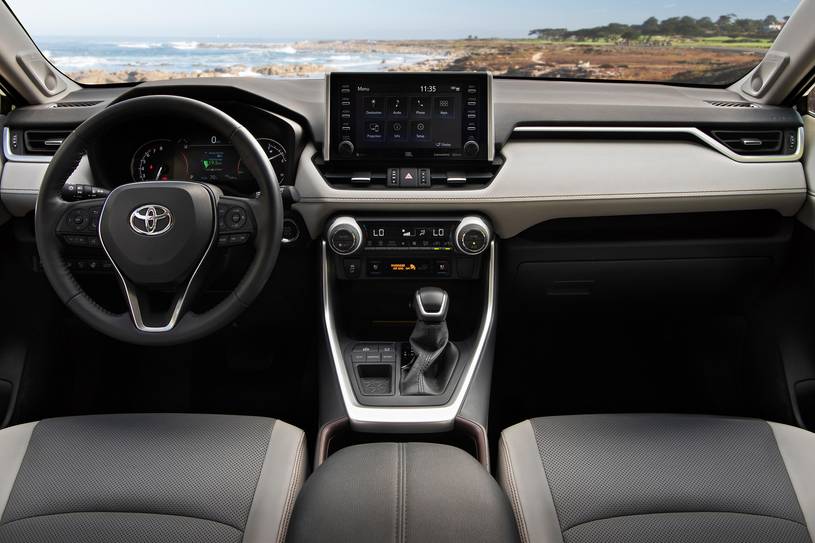
Posting a video demo probably isn't a great idea for this kind of thing. I'm sure some sicko could have figured this out just from the sound the locks make.
So I'm cutting operating costs to the bare minimum. Today I shut down one service and replaced a VPS with Cloudflare Workers. I'm also trimming my SaaS subscriptions and self-hosting what I can.
Working on this website feels so pointless if it will end up dead in a year. I just returned from a vacation and realised that I just don't like being online anymore. I'll cut my expenses to a minimum, log off, and ride a motorcycle around the world. What happens after that is anyone's guess.
Drawdown (from 52-week high) charts for top performing YTD stocks of the NASDAQ 100:
https://chartrow.com/top-performers#view=drawdown&p=ytd&in=n...
View the stock charts of holdings of an ETF like ARKK in a dense way:
https://chartrow.com/quote/arkk/holdings#range=10y&ma=20%2C5...
Microsoft business fundamental trends:
https://chartrow.com/quote/msft/trends
Visualizing the top performing stocks in different ways:
https://chartrow.com/top-performers#view=charts&p=ytd
https://chartrow.com/top-performers#view=heatmap&p=ytd
https://chartrow.com/top-performers#view=calendar&p=ytd
Feel free to change views from charts to table to heatmap etc. And it should feel responsive. Report any bugs to me and happy viewing. :)
I’m still looking for work in the mean time but I’m proud of what I’ve achieved so far.
A singing training app for bad singers. You sing the pitch line and get a score. Let's you sing to any original song by listening along and not playing the song itself.
Recently got some good feedback on HN https://news.ycombinator.com/item?id=50195488 and am following up with Linux and Windows versions and using Fable 5.1 to internationalise the app and landing page which explains the app.
University of California San Diego has deployed our Wayfinder and Waystation web apps for their 35,000+ students!
We're getting ready to launch our Vehicle Positions software, which replaces expensive, proprietary vehicle location systems with free, open source software that runs on commodity smartphones.
Our next-generation server software, Maglev, is adding support for newer transit data formats, like GTFS-Flex so that we can show demand responsive transit systems on the map.
We are always looking for more developers, biz dev, ux designers, product managers, and more to help out!
Open volunteer positions: https://ossvolunteers.com/organizations/open-transit-softwar...
Our software: https://github.com/OneBusAway/
More about us: https://opentransitsoftwarefoundation.org
It might be worth mentioning the whole reason for this to exist on the site somewhere.
In security, friction is a GOOD thing. You want to have some ceremony to do things. It's pretty much inevitable that people will give up control for convenience.
Look at Artifacts for example.
I bet Microsoft is single-handedly responsible for 80+% of complaints about email being impossible to host.
In a federated / pseudo-decentralized network, any provider with 10+% of captive users has an outsized leverage on the entire ecosystem. You don't need a monopoly; as long as you have a monopoly on just a few users that others absolutely need to be able to interact with, you can dictate terms to everybody.
"They're allowed to do it" is one of those things that doesn't really bear saying so much because that's already been implicitly established. Nobody is claiming what they're doing is illegal, so how does this add anything of value? Who is still unaware that corporations will use their size and market control to their benefit?
I haven’t productionized this setup (I send maybe a dozen emails a year) but it worked for me ad hoc a couple years back, when I had to send a mail to an Outlook-hosted address and they blackholed everything I tried to send while 250 OKing me.
[0]: As in: They accepted the email just fine (according to the logs) but it still didn't end up in the recipient's mailbox.
The people working on outlook.com are just talentless amateurs - the rest knows how to do it right. It's a shame it's so widely used.
Experience shows that the walls will get taller and the moats will get deeper.
Go to https://mail-tester.com. Send a test email. If you don't get 10/10, fix your shit.
Outlook.com and similar are an anathema to email. This is why they tell you not to run a mail server .
On the other hand rejecting domains without dmarc is fine. Just not happy it is silent.
I had kinda assumed that a lot of providers would start rejecting domains without DMARC support. I'm surprised it's happening this late.
Good for Microsoft customers and I don't care one bit for the lazy people who have to late-patch now.
Edit: tried it, and it’s definitely not better for this use case. e-means wins by needing fewer passes over a huge dataset, but relaxing a mesh on a sphere has no dataset: each Voronoi cell’s centroid can be computed directly from its geometry. Mini-batches just swap that for a noisy sampled estimate of the same thing. It has the same objective and the same optimum, so at best it matches Lloyd. In practice it was much slower and left the grid noisy, and with small sample budgets it even tangled the mesh.
[1] https://webgcm.app/explain/grid#nudging-the-cells-into-shape